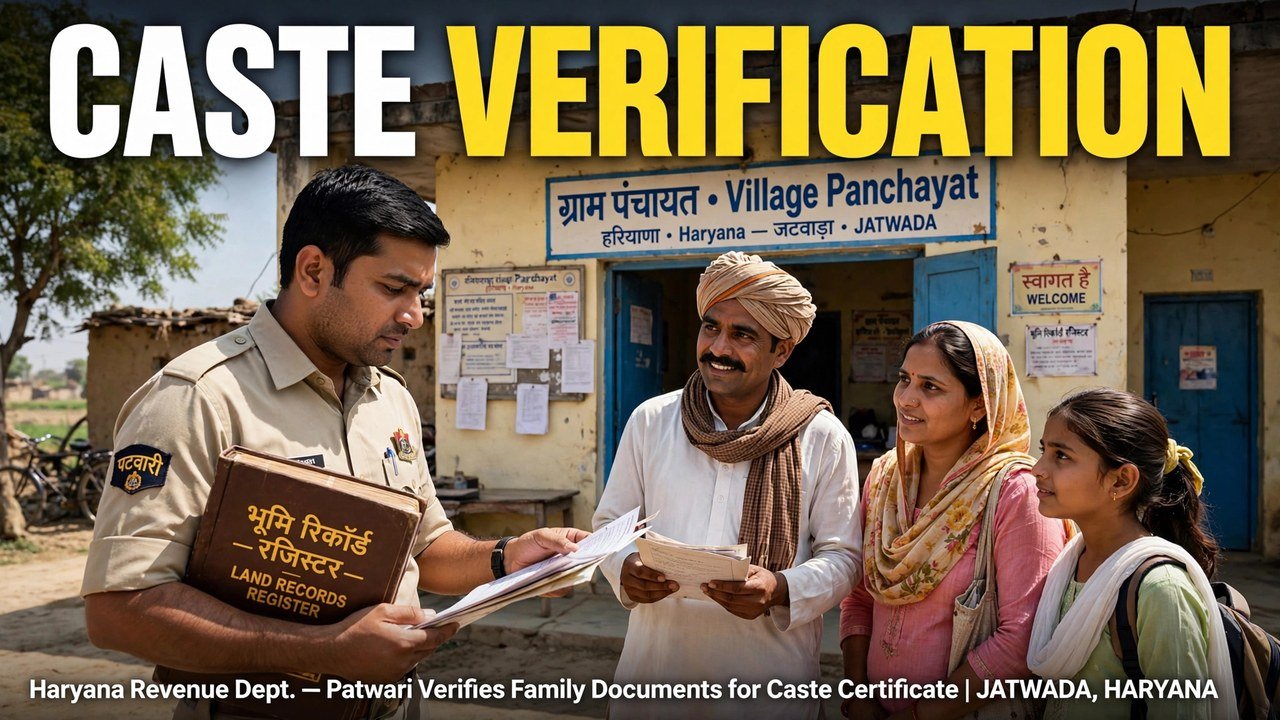
PPP Caste Verification Now Done by Patwari: The New Rule Explained
A big change has been made in the Parivar Pehchan Patra (PPP), also called Family ID, in Haryana. Now the caste details recorded in your Family ID will be verified by the Patwari of your area. Under the new rule issued by the Haryana Parivar Pehchan Authority, the Family Information Data Repository (FIDR) will forward the caste verification of a family to the Patwari who has jurisdiction over the area where the family lives. If your caste detail is wrong or is not verified yet, this new rule will directly affect your caste certificate, scholarship and scheme benefits, so every family should check its caste details in PPP today.
What Is the New Rule for Caste Verification in Family ID?
Under the new PPP rule, caste verification will work like this:
- The caste verification request of a family will be sent from the Family Information Data Repository to the Patwari of that area.
- The Patwari will verify the caste details of the family members.
- This verification will be done without revealing the caste information earlier given by the family itself. This is done so that the verification stays unbiased and is based only on the Patwari’s own record and enquiry.
- If the caste found in verification matches the caste declared by the family, it will be treated as validated and marked verified.
- If there is a discrepancy, the matter will be referred to the Kanungo for further verification. Even at this stage, the initial difference will not be disclosed.
In simple words, your self-declared caste will now be cross-checked at the ground level by the revenue staff — first by the Patwari, and in case of any mismatch, by the Kanungo.
Why Is Caste Verification in PPP So Important?
Caste data in Family ID is not just a record. It is used for official certificates and benefits.
As per the Haryana Government instructions on caste certificates, caste certificates — Scheduled Caste, Deprived Scheduled Caste, Backward Class, Other Backward Class, Tapriwas, Vimukt Jati (Denotified Tribes) and Nomadic Tribes certificates — are issued through the SARAL portal on the basis of the verified caste and income data contained in the Family Information Data Repository.
The same instructions also state that no Government department in Haryana can ask a resident to submit caste-related proof documents if he or she provides the Parivar Pehchan Number and his or her caste and caste category is marked as verified in FIDR.
This means:
- If caste is verified in your Family ID, your caste certificate process becomes easy and departments cannot demand caste proof again.
- If caste is wrong or not verified in your Family ID, your caste certificate, scholarship, reservation benefit and scheme applications can get stuck.

How Does Caste Verification Happen Step by Step?
The official process works in the following order:
- The family gives its caste details in the Parivar Pehchan Patra. Under the Haryana Parivar Pehchan Act, 2021, the Authority verifies each data field and tags it as “verified” or “not verified”.
- A resident who wants to get caste verified in PPP can make a request for verification of caste and caste category through the official online service based on the Parivar Pehchan Number.
- Under the new rule, the verification goes to the Patwari of the area. The Patwari verifies the caste without being shown the family’s self-declared caste.
- If the Patwari’s verification matches the declared caste, the caste is validated and marked verified in FIDR.
- If there is a discrepancy, the case is sent to the Kanungo for further verification, again without disclosing the difference found earlier.
- Fields that remain “not verified” are communicated to the head of the family and the member concerned for correction or for submitting a supporting document issued by a competent authority.
What Exactly Is Checked During Caste Verification?
As per the Haryana Government instructions, when a person claims caste by birth, the verification checks that:
- The person and his or her parents actually belong to the community claimed.
- The community is included in the Presidential Orders for Scheduled Castes in relation to the State, or is notified as Other Backward Class by the Government of India, or is notified as Deprived Scheduled Caste, Backward Class, Denotified Tribe (Vimukt Jatis and Tapriwas Jatis) or Nomadic Tribe by the Government of Haryana.
- The person belongs to the State in respect of which the community has been scheduled or notified.
- A person claiming Scheduled Caste or Deprived Scheduled Caste status should profess Hinduism, Sikhism or Buddhism, while a person claiming Backward Class, Other Backward Class, Denotified Tribe or Nomadic Tribe status may profess any religion.
The authorities competent to verify caste are the designated officers notified by the Citizen Resources Information Department (CRID) for rural and urban residents, while for regular government employees the verification is done as per the record available in the Human Resource Management System (HRMS). If any doubt about caste or tribe remains, the matter is referred to the Welfare of Scheduled Castes and Backward Classes Department, Haryana, and only its clarification is treated as valid.
What Happens If Caste Is Found Wrong?
Families should not give wrong caste information in PPP. As per the official instructions, if a case of misrepresenting facts comes to light, action can be initiated against the applicant, and the caste and caste category can be marked as NOT VERIFIED in FIDR. Action can also be taken against an official who issues or verifies a wrong caste certificate carelessly or deliberately without proper verification.
Once your caste detail is corrected and verified, your caste certificate issued through SARAL remains valid for lifetime, as long as the caste or tribe is not removed or modified in the government notifications. Only the certificates that carry income or asset-based information, such as creamy layer criteria, are valid for the current financial year.
What Should Family ID Holders Do Now?
- Check the caste and caste category shown for every member in your Family ID on the Mera Parivar portal or at your nearest CSC / SARAL centre.
- If caste is shown wrong, get it corrected through the official PPP correction route with proper documents.
- If caste is not verified, submit the verification request so that it can be taken up by the Patwari under the new rule.
- Cooperate with the Patwari or Kanungo verification when it happens in your area, and keep your family documents ready.
- After caste is marked verified in FIDR, apply for your caste certificate on the SARAL portal — it is issued on the basis of the verified FIDR data.
FAQs
1. Who will do caste verification in Family ID now?
Under the new PPP rule, the Patwari of your area will do the caste verification. The Family Information Data Repository forwards the verification to the Patwari who has jurisdiction over the area where the family resides.
2. What happens if the Patwari’s verification does not match my declared caste?
In case of a discrepancy, the matter is referred to the Kanungo for further verification. The difference found in the first verification is not disclosed at this stage, so that the second verification also stays unbiased.
3. Why is the Patwari not shown the caste declared by my family?
The verification is done without revealing the family’s self-declared caste so that it remains an independent and unbiased assessment based on record and enquiry, and not influenced by what the family has claimed.
4. If my caste is marked verified in Family ID, do I still need caste proof documents?
No. As per the Haryana Government instructions, no government department can ask a resident to submit caste-related proof documents if the resident provides the Parivar Pehchan Number and the caste and caste category are marked as verified in the Family Information Data Repository.
5. How do I get my caste certificate after verification?
Caste certificates are issued through the SARAL portal on the basis of verified caste and income data in FIDR. Once your caste is verified in Family ID, you can obtain the certificate through SARAL, and it stays valid for lifetime unless the caste is removed or modified in government notifications.
Source: Haryana Parivar Pehchan Authority orders on caste verification in PPP, Haryana Government General Administration Department instructions on issue of caste certificates through SARAL portal on the basis of FIDR data, and the Haryana Parivar Pehchan Act, 2021.
Also read: Family ID verification still incomplete | file a complaint about your Family ID online
Conclusion
The new PPP rule makes caste verification in Family ID a ground-level process: the Patwari will verify your caste, and the Kanungo will re-verify it if there is any mismatch, without your declared caste being disclosed at either stage. If your caste is marked verified in Family ID, your caste certificate and related benefits become smooth, because no department can ask you for caste proof again. So check your Family ID caste details today, get any mistake corrected through the official route, and complete your verification before it delays your certificate, scholarship or scheme benefits.
