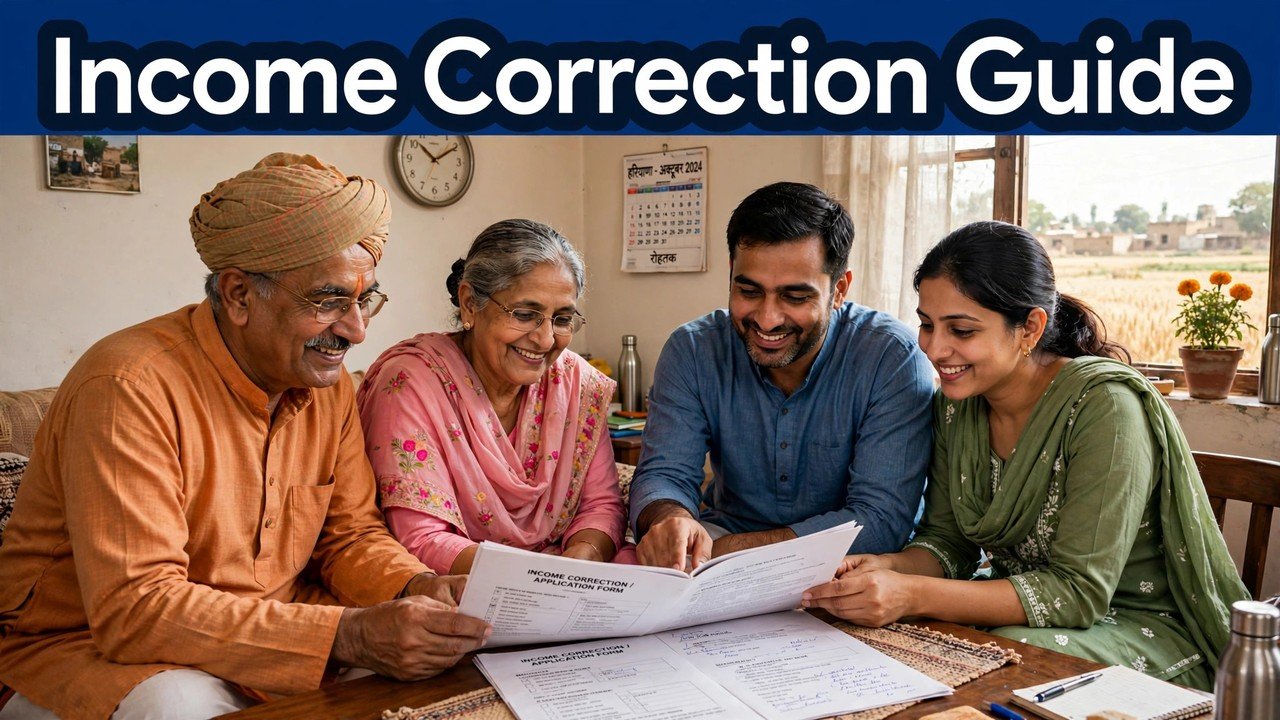
Family ID Mein Income Correction Kaise Karein? Legal Process in Simple Words
Income correction in a Family ID follows a set legal process, and it becomes much less confusing once five official words are translated into plain English. Your income starts as self-declared — what you told the system. It then becomes verified — what the system holds after checking. That checked record sits in the Family Information Data Repository, the official store behind your PPP number. If the verified figure is wrong, you do not rewrite it yourself. You contest it through the two official doors named Correction and Grievance, and a higher committee reviews a figure set locally. That sequence — declare, verify, contest, review — is the whole process.
Nothing outside that sequence changes the record. A verbal promise, a screenshot or a private note does not.
Five Official Words, Translated Into Plain English
Most families get stuck not on the steps, but on the vocabulary. Here are the five words that run this article’s process, in the order you meet them.
Self-declared means the starting figure. It is the annual income your family stated when the PPP record was made or updated. It is a claim, not yet a finding.
Verified means the checked figure. The Haryana Government told the Legislative Assembly that a self-declared income is checked through online records and through Local Committees, and the result of that checking is the verified income now stored against your Family ID. Once a field completes this stage, the portal treats it as Verified.
FIDR is short for Family Information Data Repository. Under the Haryana Parivar Pehchan Act, 2021, the information a family provides, updates or corrects, together with the status of its verification, forms this repository. In plain words, FIDR is the master copy — the version other departments read.
Correction is the first contest door. It is one of the two designated online mechanisms the Assembly reply names for challenging an income verification, including a challenge where a family has been excluded from a benefit because of the figure.
Grievance is the second contest door, filed service by service. The CRID help guide words income cases differently for different services, so the grievance you file names the service your wrong income is hurting, not just the income in the abstract.
Hold those five meanings and the stages below read as a story, not as paperwork.
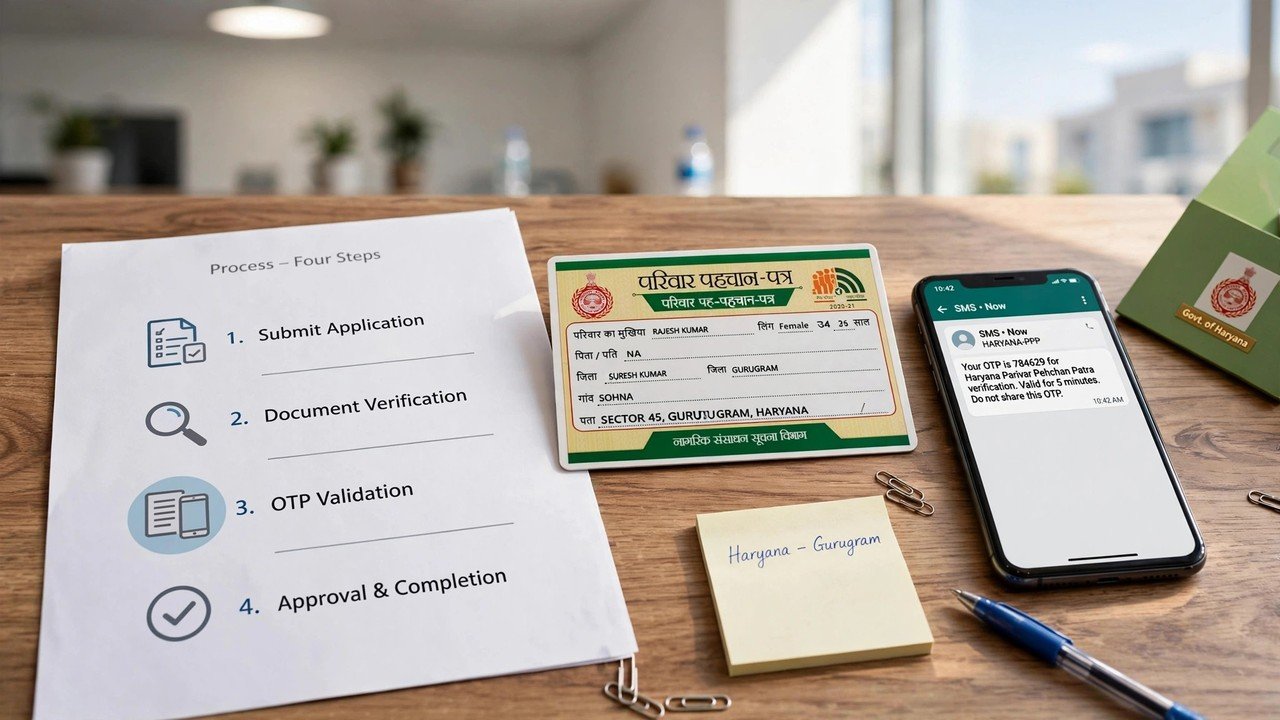
The Legal Journey in Four Stages
Stage 1 — You declare. The process begins with your own statement of annual family income. Keep this figure honest and exact, because every later stage measures itself against it.
Stage 2 — The system verifies. Verification is not one person with a stamp. The Assembly reply describes online checks using records such as tax, service, pension and other official data, alongside five-member Local Committees whose members assess independently, with the final verified figure settled through a logic-based system. The output of this stage is the verified income in FIDR.
Stage 3 — You contest, if the output is wrong. A verified field cannot be edited directly — the official citizen information is explicit that a completed verification closes the field to editing. Contesting is therefore not a workaround. It is the designed third stage, through Correction or Grievance.
Stage 4 — A reviewer decides and the record updates. A contest moves electronically for verification. If it is accepted, the corrected information joins FIDR with its verification status, and it is that updated master copy which later eligibility decisions read.
Stage 3 in Detail: Why a Second Committee Hears You
Families often ask why their case does not simply go back to the same village-level team. The Assembly reply gives the structural answer. A request challenging an income assessed by a Local Committee is pushed to a higher-level committee called a Sector Committee, with a similar composition.
In simple words, this is the appeal principle built into the process itself. The team that produced the figure is not the team that judges the challenge to it. That separation is what makes Stage 3 a legal process rather than a request for a favour — your filing creates a case, the case travels electronically to the appropriate quarters, and a different, higher body reviews it.
Filing that case, under the CRID guide, runs in this order: choose Add/view Grievance, validate with your PPP ID or Aadhaar ID and the OTP sent to the registered Head of Family mobile, select the service concerned, state the service-wise information with the income shown and the income you claim, provide the supportive documents for that service, and submit. Submission generates a ticket ID, and an SMS confirms the filing with its date, time and tracking ID.
What a Corrected Record Actually Gives You
The Act explains why correcting the master copy matters more than correcting any single benefit file. Verified information in FIDR may be accepted as conclusive proof when eligibility for a State Government scheme, service, subsidy or benefit is decided, without additional documentation. Read that in reverse and the risk is plain: a wrong verified income is not a small typo in one office. It is the proof itself, read wherever the record is used.
That is also why the Act empowers the Authority to require holders to update or correct information from time to time — accuracy of FIDR is a legal feature of the system, not a personal preference of the family. Using Correction or Grievance to fix a genuinely wrong income is therefore not asking for an exception. It is using the accuracy mechanism the Act itself provides for.
One limit belongs in this section, stated plainly. The citizen information allows only a one-time change once a citizen signs and uploads the PPP document on the portal, and a verified field stays closed to direct editing regardless. Plan a correction as a considered filing with documents ready, not as a trial edit you can repeat until it looks right.
Two Official Doors Into the Same Process — Self and Assisted
The legal process does not change with the door you enter by. The official citizen information provides two modes. In self-update mode, you authenticate with an OTP and update the record yourself; no one else is permitted to use that module for your family. In assisted mode, a CSC, SARAL Kendra or PPP Operator keys in your Family ID and edits the requisite information on your behalf.
For a verified income, both doors lead to the same contest stage — neither door reopens direct editing of a verified field. Choose self mode when you have the registered mobile for OTP and readable document copies with you. Choose assisted mode when validation, scanning or the service wording needs a counter’s help. The ticket and the electronic routing that follow are the same either way.
Source: Haryana Parivar Pehchan Act, 2021 (Haryana Government Gazette); Haryana Legislative Assembly reply on Parivar Pehchan Patra, Starred Question No. 4 (February 2023); Mera Parivar / PPP portal official citizen information, Government of Haryana; and Citizen Resource Information Department, Government of Haryana — PPP Services Grievance Redressal Help Guide (Version 3.0).
Also read: apply for income correction online | income correction rejected — what to do next
Conclusion
Translated out of official language, the legal process for income correction is a four-stage journey with no shortcuts and no dead ends: you declare an income, the system verifies it into the master FIDR record, you contest a wrong verified figure through Correction or Grievance instead of trying to edit it, and a higher Sector Committee reviews a locally assessed figure before the master copy is updated. Families who learn the five words — self-declared, verified, FIDR, Correction, Grievance — stop looking for a hidden edit button and start using the appeal the system was built with.
FAQs
1. In simple words, what is the difference between self-declared income and verified income?
Self-declared income is what your family stated. Verified income is what remains stored after that statement has been checked through online records and Local Committees and settled as the official figure. Benefits are read from the verified figure, which is why a correction case is always about the verified figure, not about what was originally declared.
2. Why is my case sent to a Sector Committee instead of back to the local team?
Because the process separates the maker of a figure from the judge of a challenge to it. Under the Assembly reply, a challenge to an income assessed by a Local Committee is pushed to a higher-level Sector Committee with a similar composition. That upward routing is built into the contest design, and it happens electronically once you file.
3. Does a corrected income change only one scheme file, or the main record itself?
It changes the main record. Information a family corrects, together with its verification status, forms part of the Family Information Data Repository under the 2021 Act, and verified FIDR information may be accepted as conclusive proof for eligibility decisions. Correct the master copy once, then recheck each benefit against that updated copy.
4. I signed and uploaded my PPP document already. In plain words, what does the one-time rule mean for me?
It means the portal allows only a one-time change after that sign-and-upload step, so treat any change as a single, prepared filing rather than a draft you can keep adjusting. For a verified income, do not spend that change trying to edit the field directly — a verified field is closed to editing, and the Correction or Grievance contest is the route that remains open.
5. Is filing through a CSC or SARAL Kendra less official than filing myself online?
No. The official citizen information provides both modes as part of the same system: self-update through OTP authentication, and assisted mode through a CSC, SARAL Kendra or PPP Operator who edits on your behalf. A verified-income contest filed with assisted help enters the same electronic routing and generates the same ticket-based record as one filed at home.
