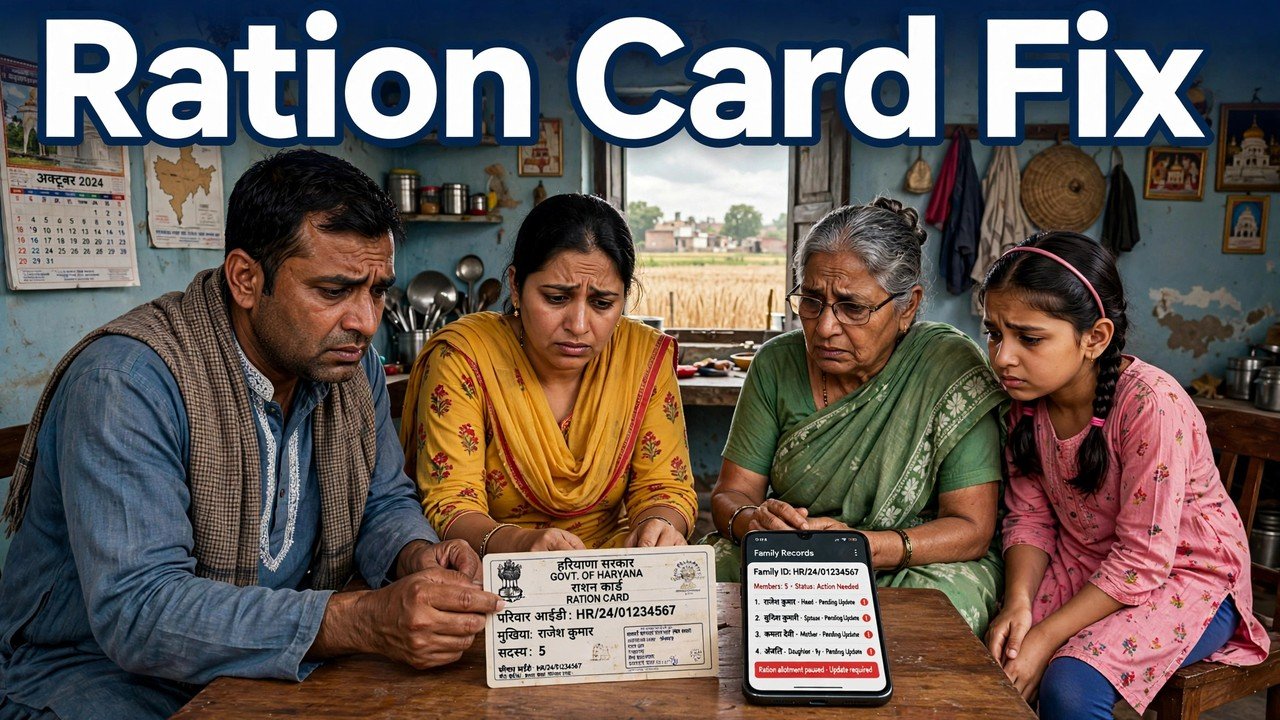
Ration Card Affected by Wrong Income in Family ID? Steps to Get It Corrected
If your ration card has stopped, changed type, or has not appeared at all, check the income recorded in your Family ID before you look anywhere else. In Haryana, a BPL or AAY ration card is not made from a separate ration application — it is generated automatically from the Parivar Pehchan Patra database when the family’s income meets the criteria of up to Rs 1.80 lakh a year. That direct link cuts both ways: when the verified income in PPP is wrongly shown above that limit, the automatic system reads the wrong figure and the ration card is the first benefit to feel it.
The fix does not start at the ration shop. It starts by confirming what EPDS shows, comparing it with the verified income in PPP, and challenging that income — or the exclusion that followed — through Correction or Grievance.
First, Confirm What Has Actually Happened to Your Card
Families often describe three different problems with the same words, “our ration card is cut”, but each one points to a different check:
- No card is shown at all when you search — the family may never have been picked up by the automatic generation, usually because the verified PPP income is recorded above Rs 1.80 lakh or the record is still being verified.
- A card exists, but not as BPL/AAY — the family is in the system, yet the income on record places it outside the BPL criteria.
- A yellow card that existed earlier is no longer active — this pattern matches what the Haryana Government described in the Legislative Assembly: after self-declared PPP data was verified, yellow ration cards were discontinued for families whose verified income did not meet the criteria.
To separate these cases, search your ration card on the official EPDS Haryana portal using your Family ID and the OTP sent to the mobile registered in PPP. Note the card type shown, or that no card is shown. That result, next to the income figure in your Family ID, tells you whether you have an income problem, a member-list problem, or a card not yet generated.
Why One Wrong Income Figure Reaches the Ration Card So Quickly
The link is automatic, so there is no separate ration-office decision in between to catch a mistake. The Assembly reply explains that the income a family declares in PPP is checked against several official data sources — among them tax-return data, government employee and pensioner records, contractual employee data, labour-wage data, payments to farmers for crop procurement, and annual electricity consumption — and is also assessed by Local Committees of five members, each assessing independently.
If any check pushes the assessed figure above Rs 1.80 lakh, the verified income stored in PPP rises with it, and the ration system works from that stored figure — not from what the family actually earns. Arguing only at the fair price shop cannot solve it: the shop follows the card record, and the card record follows PPP. The correction has to happen in PPP first.
The Correction Sequence, in the Order That Matters for Ration
Work through these steps in order, and do not skip the first two.
- Record the two income figures. Write down the income your family actually has and the verified income shown in PPP. If the PPP figure is up to Rs 1.80 lakh and the card is still missing, the problem may lie elsewhere, such as the member list — say so instead of filing an income challenge.
- Save the EPDS result. Note the card type EPDS shows today, or that no BPL/AAY card is shown. This is the ration-side evidence that the wrong income has had a real effect.
- Open the Correction or Grievance route on PPP. The Assembly reply names these as the designated online mechanisms for contesting income verification, including challenges to exclusions. An exclusion challenge is exactly the ration situation: the family has been left out of a benefit because of the verified income.
- File through the grievance flow if you use Grievance. Enter your PPP ID or Aadhaar ID, complete the OTP sent to the registered or Head of Family mobile, check the Head of Family name and address shown, select the relevant service, give the service-wise information — here, state the income shown, the income you say is correct, and the ration card effect from Step 2 — and provide the supportive documents that service asks for on screen.
- Submit once and keep the ticket ID. On submission a ticket ID is generated and an SMS confirms the filing with its date, time and tracking ID. Keep both; they are how this specific challenge is followed.
- Let the routing run. The official reply states that every exclusion challenge is pushed electronically and automatically for online verification, and that a challenge to income assessed by a Local Committee goes up to a higher Sector Committee. You do not need to visit offices to move the file from one level to the next.
- Re-check EPDS after the PPP income changes. Once the verified income in PPP is corrected, search EPDS again with your Family ID. Because BPL/AAY cards are generated automatically from the PPP database under the income criteria, there is no separate BPL application to file after the correction — the re-check is how you confirm the ration side has followed the corrected record.
The official sources do not state a fixed number of days for this to finish. The ticket ID, not a date promised in a video, is the reliable way to follow the case.
Two Ration Problems That Are Not Income Problems
Not every missing ration benefit is caused by income.
If a member who should be on the card is missing from the Family ID, or a member who has left is still listed, the card follows that member list. That needs a member correction in PPP, separate from an income challenge.
If EPDS shows the correct BPL card but grain was not received in a particular month, that is a distribution matter for that month, not a PPP income error. Confirm the card is active on EPDS, then raise it through the food and supplies channel for that shop.
What to Avoid While Your Ration Case Is Open
Do not file a fresh BPL application through an unofficial form or agent — no separate application is required, because generation is automatic from PPP data. Paying for such a form cannot change the verified income that caused the problem.
Do not file a duplicate challenge while the first ticket is still open, and do not accept a verbal assurance instead of a filing. The case counts when it is in the official system with a ticket ID.
Source: Government of India, Rajya Sabha reply on food distribution conveying the Haryana Government position on automatic BPL/AAY ration cards through PPP (February 2024); Haryana Legislative Assembly reply on Parivar Pehchan Patra, Starred Question No. 4 (February 2023); Citizen Resource Information Department, Government of Haryana — PPP Services Grievance Redressal Help Guide (Version 3.0); and EPDS Haryana, Food, Civil Supplies and Consumer Affairs Department, Government of Haryana.
Also read: apply for income correction online | after income correction, how long does a BPL ration card take | BPL ration card not made yet
Conclusion
A ration card problem in Haryana is often a Family ID income problem wearing a different name. Because BPL and AAY cards are generated automatically from PPP data for families with income up to Rs 1.80 lakh a year, a wrongly high verified income shuts the ration door without any separate ration decision. Confirm the position on EPDS, compare it with the verified income in PPP, challenge the income or the exclusion once through Correction or Grievance and keep the ticket ID, let the case move through online verification or to a Sector Committee, and then re-check EPDS once the PPP record is corrected. Fix the record, and the card follows the record.
FAQs
1. My ration dealer says my name is removed, but my real income is low. Where is the fault recorded?
Start with PPP, not the shop. Search EPDS with your Family ID to confirm the card position, then compare it with the verified income in your Family ID. If that verified figure is above Rs 1.80 lakh, the automatic system has treated the family as outside the BPL criteria, whatever the real income is.
2. Do I need to apply again for a BPL card after my income is corrected in PPP?
No separate application is described in the official position: BPL/AAY cards are generated automatically from the PPP database according to the income criteria. After a correction, re-check your card on EPDS using your Family ID to confirm the updated position.
3. Can I challenge only the ration exclusion, without challenging the income itself?
The Assembly reply covers both together: families can contest income verification through Correction and Grievance, including challenges to exclusions, and every exclusion challenge is pushed electronically for online verification. In your filing, state both the income you dispute and the ration effect it caused.
4. My yellow card was active earlier and then stopped. Is that a known pattern?
Yes, the government told the Legislative Assembly that, after verification of the self-declared data given at PPP registration, yellow ration cards were discontinued for families whose verified income did not meet the criteria. If your actual income still meets the criteria, the route back is to challenge the verified income, not to apply for a fresh card.
5. The EPDS search shows no card, but my PPP income is already below Rs 1.80 lakh. What should I check next?
Check the member list in your Family ID and whether the record’s verification is complete, because the automatic generation reads the whole PPP record, not the income line alone. If the member list is wrong, that correction is separate from an income challenge; if the record looks correct, raise the matter through the PPP Grievance route with your EPDS result noted.
