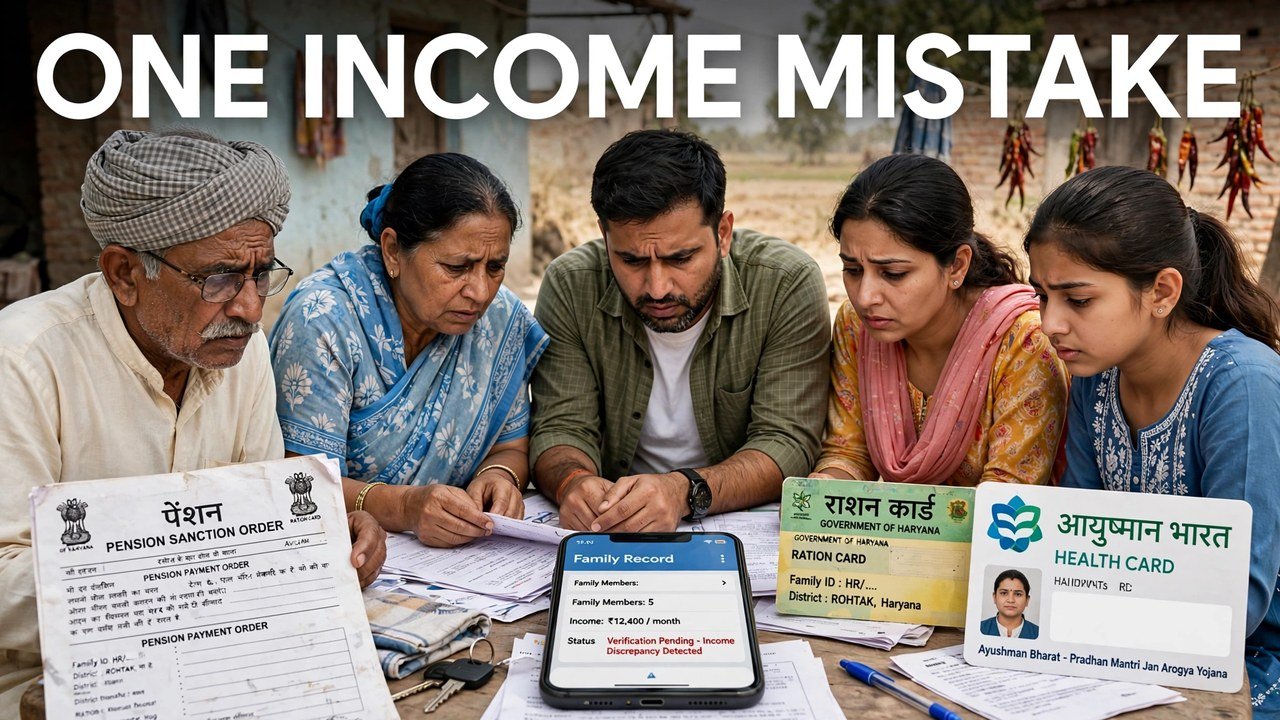
One Income Mistake in Family ID Can Affect Pension, Ration and Ayushman Together: How to Fix It
When a pension difficulty, a ration problem and an Ayushman problem appear in the same family at almost the same time, families often treat them as three separate faults. In PPP they frequently have one shared cause: the single verified family income stored in the Family ID. Pension, the BPL ration card and Ayushman Bharat are all read from that same family record, so one income figure recorded too high can fail three different eligibility checks together. The fix therefore starts at the source figure, not at three different counters: read the income stored in PPP, and challenge that one figure through Correction or Grievance.
Fixing the three symptoms separately, without correcting the income they all read, leaves the cause untouched.
Three Problems, One Figure on File
The official NIC Haryana description of PPP explains why the problems travel together. PPP holds one family database under a single 8-digit Family ID and verifies socio-economic data for use across government services — the page puts the integration at over 400 services and schemes. Eligibility is not worked out from a fresh income paper for every benefit. It is worked out from the verified record already held.
That page also describes the proactive side of the system: eligible citizens are automatically identified from the database, contacted for consent, and, once approved, receive benefits from the following month. The proactive services it names include Old Age Pension, Widow Pension and Divyang Pension, the BPL Ration Card, and Ayushman Bharat Medical Insurance.
Read those two facts together and the pattern in this article’s title becomes mechanical, not mysterious. Automatic identification is helpful when the record is right. When the income in the record is wrong, the same automatic reading can hold back every income-linked benefit that depends on it.
How Each of the Three Reads the Same Income
The three benefits do not use income in identical ways, but they all start from the PPP figure.
Pension. Old Age, Widow and Divyang pensions appear on the official proactive list, which means the PPP record is used to identify who qualifies. The grievance guide also treats pension income as a distinct case, with income wording for the beneficiary — and, for Old Age Samman Allowance, for the beneficiary and spouse together. A family income pushed too high, or a beneficiary income read wrongly inside it, can therefore surface as a pension problem even though the pension office did not create the figure.
Ration. The Haryana Government told the Legislative Assembly that yellow ration cards were given to families with annual income up to Rs 1.8 lakh under the criteria it stated. That makes the ration test unusually sensitive to a single figure: an income recorded just above that line and an income recorded just below it lead to different outcomes, even if the family’s real earnings did not change at all.
Ayushman. Ayushman Bharat Medical Insurance is also named among the proactive services drawn from PPP, and the grievance guide lists an income case for it in family terms. Where the family income on file is the figure being read, one overstated total can affect health cover for the household as a whole, not only for the member whose earnings were misread.
Three doors, one key — and the key is the verified income in the Family ID.

First, Confirm It Really Is One Shared Mistake
Before filing anything, test the shared-cause theory against your own record. It takes one careful reading.
Open your PPP record and note the annual family income exactly as stored, and whether it is shown as verified. Then write, next to it, the three problems in the order you noticed them and the date each one appeared. If all three began after the income was verified or changed, and the stored figure is higher than your family’s actual annual income, one shared mistake is the likely explanation.
If, instead, the stored income is correct and only one benefit has a problem, do not file an income challenge you cannot support. A single-benefit problem with a correct income points to that benefit’s own detail — for example a member detail or a bank detail — and should be taken up for that service. This article’s route is for the case where the income itself is wrong.
Keep the note you make at this stage. The shown figure, the figure you claim, and the member whose earnings were misread are the three facts your filing will need.
Fix the Source Figure Once — Do Not Chase Three Counters Separately
The contest route for a verified income is the same wherever the symptom appeared. The Assembly reply states that families can contest income verification through the designated online mechanisms, Correction and Grievance, including challenges to exclusions, and that a challenge moves electronically for verification — with a Local Committee-assessed figure going to a higher Sector Committee.
File it in this order:
- Validate through the PPP route with your Family ID or Aadhaar ID and the OTP sent to the registered Head of Family mobile.
- Choose the service where the harm is clearest first — pension, ration-linked or Ayushman — because the grievance guide works service by service and words its income type for that service.
- State the stored annual income and the annual income you say is correct, side by side, and name the member whose earnings were misread.
- Provide the service-wise information and supportive documents that service asks for, then submit.
- Save the ticket ID generated and the confirmation SMS with its date, time and tracking ID.
A verified income cannot simply be typed over in the update screen, so do not spend the attempt looking for an edit option for that field. And if you want the detailed, scheme-by-scheme walk-through of the grievance screen itself, it is covered in the earlier guide on using the Grievance option for a wrong family income.
After the Figure Is Corrected, Recheck Each Benefit Separately
Correcting the source figure and seeing the benefit return are two different moments, and families should plan for both.
Once the income on the record is corrected, go back to each of the three benefits in turn and check its position against the corrected record. Under the proactive model described by NIC Haryana, eligible citizens are identified from the database and contacted for consent, with benefits provided from the following month once approved — so a corrected record still passes through identification and approval before a benefit flows. The sources do not promise that pension, ration and Ayushman will all move on the same day.
Use the ticket status, not assumption, to judge the income case itself, and keep the ticket ID, the confirmation SMS and your original note together. If a benefit still does not move after the income is corrected and a reasonable check of its own status, take that single benefit — with the corrected PPP record in hand — for assisted help at a CSC, SARAL Kendra or through a PPP Operator.
Source: National Informatics Centre, Haryana (Government of India) official page on Parivar Pehchan Patra; Haryana Legislative Assembly reply on Parivar Pehchan Patra, Starred Question No. 4 (February 2023); Citizen Resource Information Department, Government of Haryana — PPP Services Grievance Redressal Help Guide (Version 3.0); and Mera Parivar / PPP portal official citizen information, Government of Haryana.
Also read: how to fix the income mistake in your Family ID | benefits linked automatically with Family ID | check income in Family ID online
Conclusion
Pension, ration and Ayushman failing together is rarely three coincidences. In a system where one verified Family ID income feeds the identification for all three, a single overstated figure can close three doors at once — and the repair is equally single: prove the stored income wrong through one Correction or Grievance filing, then patiently recheck each benefit against the corrected record. Families who start at the shared figure save themselves the exhausting round of three offices, each pointing back to the same record.
FAQs
1. Do I have to file three separate income corrections — one for pension, one for ration and one for Ayushman?
No — the income figure itself is one figure in one PPP record, and that is what a Correction or Grievance challenge contests. The grievance filing is lodged under a service, so start with the service where the harm is clearest, keep its ticket ID, and then recheck the other benefits against the corrected record.
2. My pension is affected but my ration card is still working. Can the income still be the cause?
Yes, it can. The three benefits read the record in different ways — pension cases in the grievance guide are worded around a beneficiary’s income, and for Old Age Samman Allowance the beneficiary and spouse, while the ration test in the Assembly reply turns on the family’s annual income against the Rs 1.8 lakh criteria. One wrong figure can therefore cross one test’s line before it crosses another’s.
3. Once my income is corrected in PPP, will all three benefits restart on the same day?
The official proactive model does not promise a single shared restart day. NIC Haryana describes eligible citizens being identified from the database, contacted for consent, and receiving benefits from the following month once approved. Check each benefit’s own position after the correction instead of assuming all three moved together.
4. The income in my PPP is correct, but Ayushman is still not working. Should I still file an income grievance?
No. If the stored income matches your real annual income, an income challenge has nothing to correct. Take the Ayushman problem up as that service’s own case, with your correct PPP record as supporting evidence, rather than disputing a figure that is right.
5. Which single document set should I keep from start to finish for a three-benefit case?
Keep one small set together: your note of the income shown and the income claimed with the member’s name, the ticket ID from the filing, and the confirmation SMS showing its date, time and tracking ID. That set connects the cause, the filing and the follow-up for whichever benefit you are rechecking.
